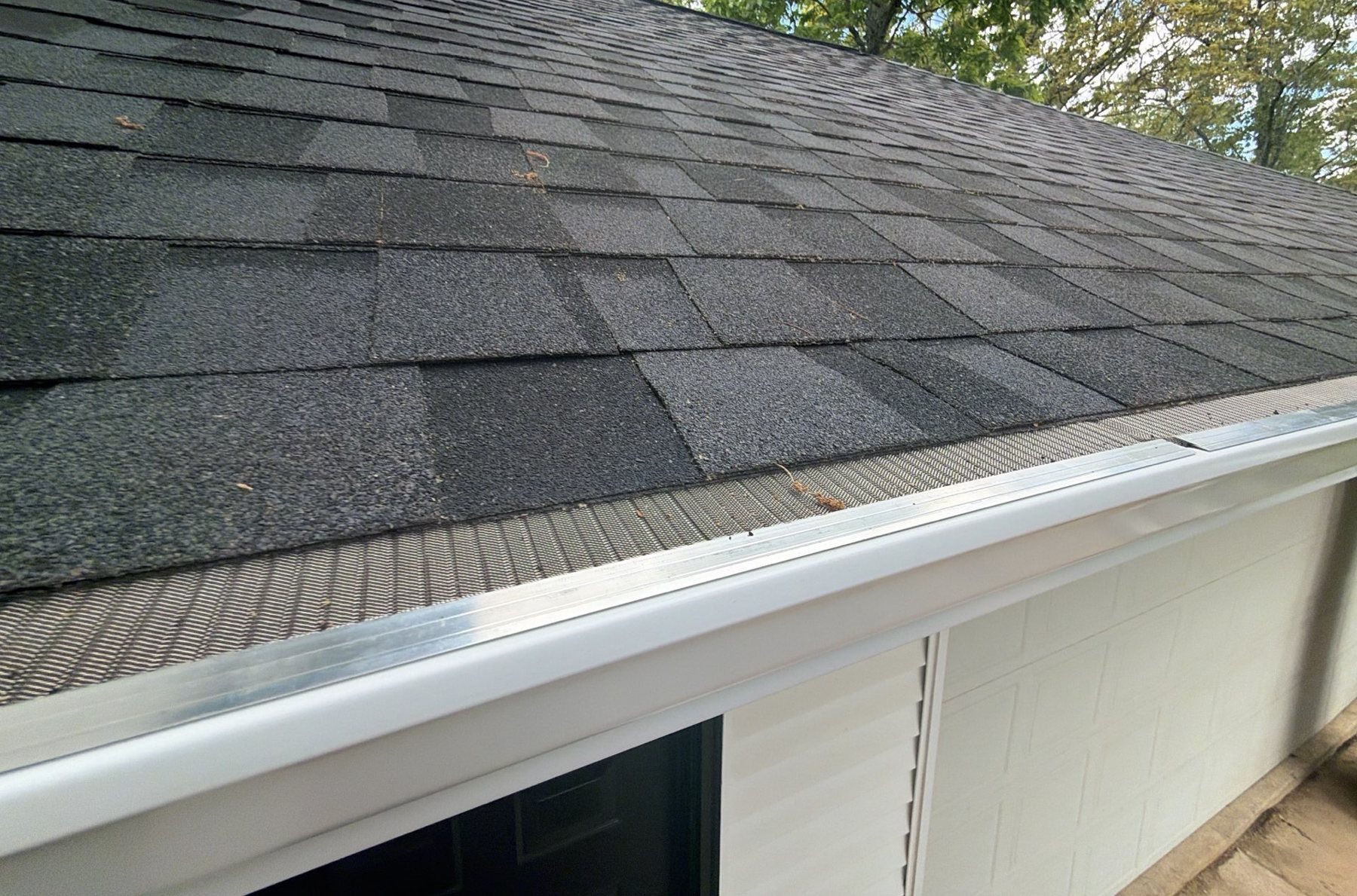
Gutter Guards from Keys Roofing
Gutter guard systems are one of the standing service lines at Keys Roofing. We install them as part of our gutter and downspout work, held to the same standards for pitch, hangers and seams, whether or not we are working on your roof. The question we hear most is not "do gutter guards work," it is "will they hold up against my trees." In oak and maple country, that is the right question.
This page covers guards only. For seamless gutters, repair and realignment, downspouts and drainage, see gutters and downspouts. For why we treat the roof, gutters and downspouts as one system, read Gutters and Downspouts: The Part Everyone Ignores.
Why Oak and Maple Trees Change Which Guard Works
St. Louis is oak and maple country, and that matters more than most guard manufacturers let on. A guard rated for a pine-heavy yard in a different climate can behave completely differently after a season under a mature white oak or silver maple.
Oaks and maples do not drop their leaves once and stop. They shed all season:
- Maple seed pods in late spring.
- Small, serrated maple leaves that slip through openings a bigger leaf never would.
- Oak catkins and acorn debris that build up as a fine, compacted layer rather than a loose pile.
A guard that is excellent at stopping big leaves can still let this smaller, steadier debris through, and that is the debris our St. Louis customers deal with most. Guard performance depends as much on the debris load above the roofline as it does on the guard itself. More in Gutter Guards in the Midwest: Which Ones Survive Oak and Maple Country.
Gutter Guard Types Compared
Here is how screen and mesh, reverse curve, foam and micro mesh guards handle oak and maple debris.
| Guard type | What it does well | Under oak and maple |
|---|---|---|
| Screen and mesh | Affordable, easy to install, keeps large leaves out | Seed pods and small debris sit on top of the screen instead of washing off |
| Reverse curve (surface tension, hooded) | Handles whole leaves and sheds much of the coarser debris on its own | Needs a precise install tied to the roof's drip edge and pitch |
| Foam inserts | Least expensive, easiest to retrofit onto an existing gutter | Traps fine debris inside the foam, which breaks it down faster |
| Micro mesh | Fine weave stops maple seed pods and fine oak debris | Costs more, and fine grit and pollen can build up on the weave over time |
Screen and mesh guards are not a bad choice, but they are not an install-and-forget choice in this climate. The layer of pods and debris that settles on top of the screen eventually acts like its own miniature gutter, holding moisture and organic buildup right on top of the guard.
Reverse curve guards use the roof's own water flow to pull water down and around a curved lip while debris slides off the front edge. They perform best when the install is done precisely, which is the kind of detail work we hold our crews to.
Foam inserts are tempting because they are cheap, but the organic material trapped inside the foam breaks it down faster and can hold moisture against the gutter longer than an open system would. We do not install foam as a primary system on wooded St. Louis lots.
The Best Gutter Guards for Oak and Maple Trees
For a heavily wooded St. Louis property, micro mesh is usually the closest thing to low maintenance that still holds up honestly. Its much finer weave is what actually stops the small maple seed pods and fine oak debris that standard mesh lets through. The trade-off is airflow and cost: a tighter weave gives fine grit and pollen more surface to collect on over time, and a quality micro mesh system costs more than screen or foam.
Reverse curve guards handle whole leaves well and shed a lot of the coarser oak and maple debris on their own, but they depend on an install matched closely to the drip edge and pitch.
Which system makes sense depends on the trees actually on your property, not a generic recommendation. We look at the specific canopy over your roof before we recommend a guard, rather than selling the same guard to every house on the street.
Are Gutter Guards Worth It in Missouri?
They can be, if the guard is chosen for your trees and installed on a gutter that is pitched and hung right. Here is what a good guard system actually does: it stretches the time between cleanings and stops the kind of blockage that causes overflow and water damage.
Blockages are the real cost. A gutter full of debris behaves like no gutter at all during a heavy rain, and it puts extra weight on hangers that were never designed to hold standing debris and water at the same time. Then winter arrives. Leaves fill St. Louis gutters in October and November, and a clogged gutter in a freeze becomes a heavy block of ice that backs meltwater up under the shingle edge. Most of the gutter damage we repair in spring was set up the previous fall.
What a guard will not do is end maintenance. We will not tell anyone under a mature oak or maple canopy that any guard system means zero maintenance, because it does not. Guarded gutters still need maintenance, and the parts of our fall gutter checklist for St. Louis homes that have nothing to do with leaves still apply: pitch and hangers, seams and corners, and where each downspout actually puts the water.
Installation Matters More Than the Brand
A guard system is only as good as the gutter and roofline it is attached to. If the pitch is off or the hangers are wrong underneath, no guard on top fixes that, and a guard installed on a poorly set gutter just hides a problem instead of solving one. Pitch and hanger spacing are set when a gutter is installed and are hard to fix later without redoing the run, so a gutter with those problems needs repair and realignment or a new seamless run, not just a guard.
That is why we treat gutter guard installation as an extension of the same gutter and downspout craft we hold every install to, not a bolt-on accessory. Kaleb, who owns Keys Roofing, is directly involved in material selection and installation standards on every project. Gutter work gets the same photo documentation as every roof Keys touches, and if something from the install does not sit the way you expected, we come back and finish it without an invoice. More in what free service means at Keys.
Not sure what shape your gutters are in? A free roof inspection covers them too: we check pitch, hanger spacing, seams and how much debris is sitting in the run along the full gutter, then follow each downspout to where it discharges. We go through the photos with you before we talk about scope or price.
Where We Install Gutter Guards
Keys Roofing installs gutter guard systems throughout St. Louis County, including Chesterfield, Ladue, Frontenac, Town and Country, Clayton, Kirkwood, Webster Groves, Creve Coeur, Wildwood, Ballwin, Olivette, Brentwood, Richmond Heights and University City. We also cover Sunset Hills, Crestwood, Maryland Heights, Valley Park, Eureka, Fenton, Oakville, Sappington, Affton and Overland, and beyond the county line in St. Charles, O'Fallon, Wentzville and Arnold, all within a 50-mile service radius. The full list of towns and zip codes is on our service areas page.
Estimates are free, we respond to every inquiry within 24 hours, and the company is fully licensed and insured. Call (314) 220-2333, Monday through Saturday, 7am to 7pm, or email contact@keysroofing.com.