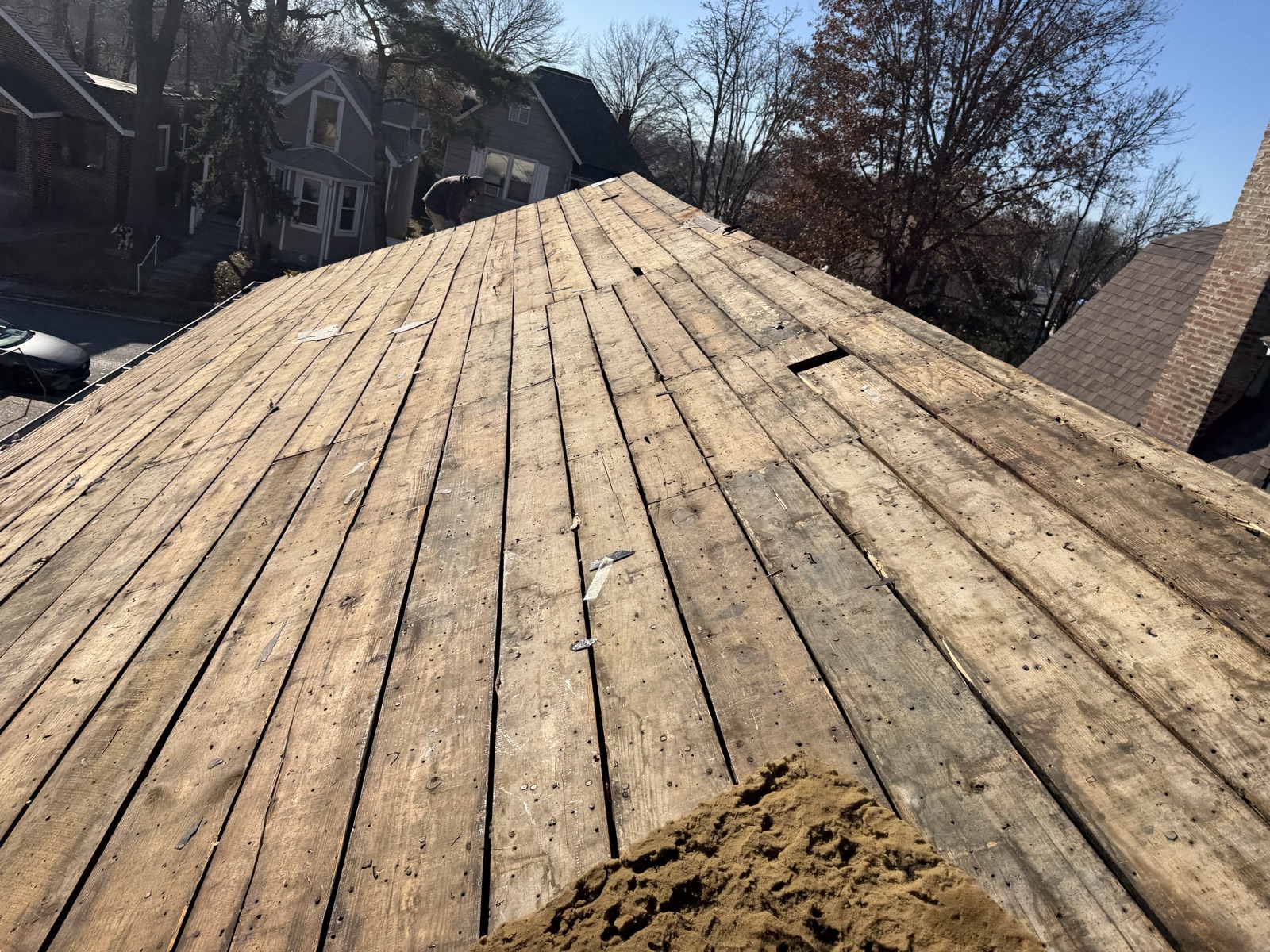
What a Full Roof Replacement Includes
A new roof is more than new shingles. When Keys Roofing replaces your roof, every layer is rebuilt in order, as laid out in the anatomy of your roof, from deck to ridge:
- Tear-off to the deck, so the wood underneath can be seen.
- Decking checked. Soft, rotted or delaminated wood does not hold nails, so we replace what is compromised before anything goes back on. We never shingle over bad decking.
- Ice and water barrier at the eaves, valleys and penetrations, where ice dams and storm debris back water up.
- Underlayment across the rest of the deck, the second line of defense if wind lifts a shingle.
- Drip edge and starter course, so the edges shed water into the gutter and the first row seals straight.
- Flashing at chimneys, walls, valleys and pipes, in layered metal: step and counter flashing at the chimney, kick-out flashing where a roof meets a wall. Never caulk in its place.
- Ventilation and ridge: intake at the soffits, exhaust at the ridge, in balance, closed with ridge cap shingles.
Comparing quotes? Ask every bidder what theirs includes for each line above. Vague answers usually mean missing parts, not a lower price.
Atlas and Malarkey Shingles, Installed to Spec
Keys Roofing is a proud installer of Atlas and Malarkey shingles, and we standardize on those two on purpose. Our crew knows their install specs, fastening patterns and flashing details cold, and we follow each manufacturer's fastening pattern so the shingle keeps the wind rating class it was tested for. Read why we install Atlas and Malarkey.
For a home you plan to live in, we recommend architectural shingles almost every time. Laminated from two or more layers with no through-slots, they generally rate stronger in wind and handle St. Louis freeze-thaw cycles better than flat three-tab. More in architectural vs. three-tab shingles.
How a Replacement Works with Keys Roofing
- Free inspection with photos. We walk your roof from the ridge down to the gutter line, section by section, photographing shingles, ridge, valleys, pipe boots, vents, gutters and downspouts. Here is how we inspect a roof.
- Review before any price. We go through every photo with you before we talk about scope or cost. If your roof does not need replacing, we say so.
- A written scope, with photographs and measurements, so you see what is being replaced and why.
- Permits handled. St. Louis County alone has close to ninety municipalities, each with its own rules. We confirm your jurisdiction, file before work starts, and close the permit out where one is required. You never pull a permit for our crew. See roofing permits in the St. Louis area.
- The build: tear-off, deck check, underlayment, flashing, shingles, cleanup, and a final photo record of the finished roof.
- The punch list. If something is not sitting right afterward, we come back and finish it without an invoice.
Kaleb, who owns Keys Roofing, is on job sites personally, inspecting, documenting and standing behind the crew's work.
When the Replacement Is Storm-Related
If hail or wind damaged your roof, the paperwork changes but the build does not. We inspect and photograph before you file and tell you straight whether the damage is worth a claim. Missouri law does not let a roofing contractor negotiate your insurance claim, so the claim stays yours.
What we handle is documentation and coordination. We meet your adjuster at the property as the contractor, go through the carrier's scope line by line, and after the build our office sends the completion paperwork so the depreciation the carrier held back gets released. See a hail claim from start to finish.
Two Warranties, and Who Stands Behind Each
A new roof carries two warranties from two different parties, decoded in roof warranties: manufacturer vs. workmanship:
- Manufacturer warranty, from Atlas or Malarkey, covers factory defects in the shingles. Read it for proration, included labor and transfer rules.
- Workmanship warranty, from Keys Roofing, covers errors in the installation. Ours is in writing, and we walk you through it line by line.
Storm damage belongs to neither: that is an insurance claim. The two meet at installation, because shingles installed off spec, including over an attic that cannot breathe, can give a manufacturer grounds to deny a claim. That is why we treat the spec sheet as a floor and check attic ventilation on every roof.
Signs It Is Time to Replace, Not Repair
Most leaks start at a detail, and a cracked pipe boot or a lifted piece of step flashing is a repair, not a reason for a new roof. Replacement makes sense when the problems are spread across the shingle field:
- Granule loss across whole slopes. Granules are the shingle's UV shield.
- Curling, cracking or lifted tabs on many sections, the first entry points for wind-driven rain.
- Hail soft spots and bruised shingles on more than one slope.
- Shingles that look older than they are, often from an attic cooking them from below.
Not sure which side of the line you are on? That is what the free inspection is for. If a repair will do, see our roof repair page.
Where We Replace Roofs
Keys Roofing is locally owned in St. Louis and replaces roofs throughout St. Louis County, including Chesterfield, Ladue, Town and Country, Frontenac, Creve Coeur, Clayton, Kirkwood, Webster Groves, Wildwood, Ballwin, Olivette, Brentwood, Richmond Heights and University City. We also work in Sunset Hills, Crestwood, Maryland Heights, Valley Park, Eureka, Fenton, Oakville, Sappington and Affton, and beyond the county line in St. Charles and Wentzville, all within a 50-mile service radius.