Where Roof Leaks Actually Start
Most leaks do not start in the middle of the shingle field. They start where the roof meets a chimney, a wall, a valley or a pipe, so that is where we look first. More in flashing: where roofs actually leak.
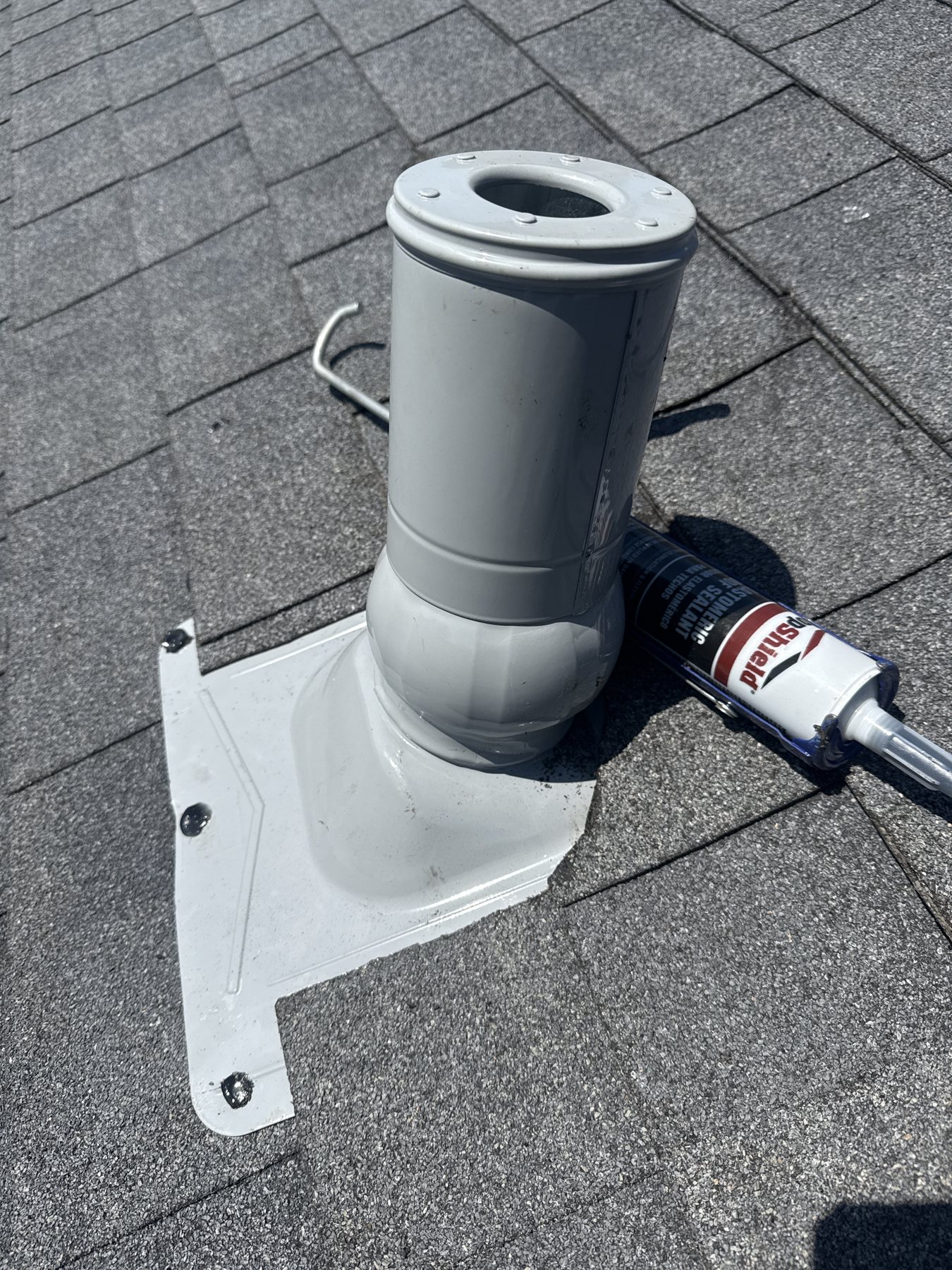
- Pipe boots. The rubber or plastic collar around a plumbing stack dries, cracks and splits in the sun years before the shingles are done, then leaks down the outside of the pipe, often for a long time before a stain shows.
- Chimney flashing. Step flashing woven into each shingle course, with counter flashing set into the mortar and lapped over it. A smear of roofing tar is not flashing.
- Walls and dormers. Step flashing along the run and a kick-out at the bottom to throw water into the gutter. A missing kick-out quietly rots the sheathing behind your siding.
- Valleys. A valley carries more water than any other line on the roof. Debris sitting in it dams the channel and pushes water under the shingle edges.
- Ice dams at the eaves. A warm attic melts snow that refreezes at the cold eaves and backs water up under the shingles. The lasting fix is often attic ventilation.
Missing, Lifted and Storm-Damaged Shingles
Wind works on edges. Curled or lifted shingles are the first entry points for wind-driven rain, and on a three-tab roof a storm can crease, fold or tear tabs at the slots. On a partial repair to an older three-tab roof, matching the existing shingle is one of the few cases where three-tab still makes sense. Hail damage is often quieter: soft spots in the shingle mat, granule loss and bruised tabs.
You can check a lot from the ground: granules piled at the downspouts, shingle pieces or metal in the yard, lifted edges along the ridge, fresh clustered dents in the gutters, dinged vent covers. See reading your roof after a storm. If it looks like a claim, we inspect and photograph before you file, tell you honestly whether it is worth filing, and meet your adjuster at the property. Missouri law does not let a roofer negotiate your claim, so it stays yours.
Emergency Repairs and Our 24-Hour Response Time
When water is coming in, you need an answer fast. Keys Roofing has a 24-hour response time: we respond to every inquiry within 24 hours, and post-storm emergency response is part of what we handle for homeowners. Call (314) 220-2333, Monday through Saturday, 7am to 7pm.
You do not need to get on the roof while you wait. Photos of any ceiling stain, with the date, and a look in the attic with a flashlight help us more than a ladder ever will.
Why a Small Leak Should Not Wait for Spring
The drip in the bucket is only the water that made it through. The damage happens on the way, mostly to the decking your roof is nailed to. Through a St. Louis winter of freeze-thaw cycles, wet plywood delaminates, OSB swells at the edges, snow and ice feed the leak for days at a time, and nails in softened wood hold less.
Caught in the fall, a small leak is usually a detail repair: reseat or replace a boot, correct a piece of flashing, and confirm the wood below dried out. In spring, the same leak often adds replacing decking that can no longer hold a fastener, plus interior work if the stain spread. See what a small leak does to decking in one Missouri winter. Before the first hard freeze is the cheap time to look.
How We Find the Problem and Document the Fix
Water runs along the framing before it drops, so a ceiling stain is rarely right under the entry point. We do not guess. We walk the roof the same way every time, ridge down to the gutter line, photographing shingles, ridge, valleys, every pipe boot, vents, gutters and downspouts. Here is how we inspect a roof. Then we go through the photos with you before we talk about scope or cost. If the roof does not need work, we say so.
Repairs are done the honest way: layered metal flashing, not caulk that lasts a couple of summers, and soft decking cut out and replaced, never shingled over. If a flashing or vent detail is not sitting right afterward, we come back and correct it at no charge. Kaleb, who owns Keys Roofing, is on job sites personally, inspecting, documenting and standing behind the crew's work.
When a Repair Is Enough, and When It Is Not
A repair is the right call when the problem sits at one detail and the rest of the roof is sound: a split pipe boot, a lifted piece of step flashing, a nail that backed out, a few shingles lost to wind, or a valley that needs its channel cleared. A pipe boot often fails well before the shingles around it need replacing, and a shingle field laid properly sheds water for decades.
Replacement starts to make sense when the damage is spread across the field: granule loss on whole slopes, curling and cracking across many sections, hail soft spots on more than one slope, or shingles aging ahead of their years. We will tell you which side of that line your roof is on, with photos to show why. If it is replacement, our roof replacement page explains what that includes.
Where We Repair Roofs
Keys Roofing repairs roofs throughout St. Louis County, including Kirkwood, Webster Groves, Clayton, Ladue, Frontenac, Creve Coeur, Chesterfield, Town and Country, Wildwood, Ballwin, Olivette, Brentwood, Richmond Heights and University City. We also cover Sunset Hills, Crestwood, Maryland Heights, Valley Park, Eureka, Fenton, Oakville, Sappington, Affton and Overland, and beyond the county line in St. Charles, Wentzville and Arnold, all within a 50-mile service radius.