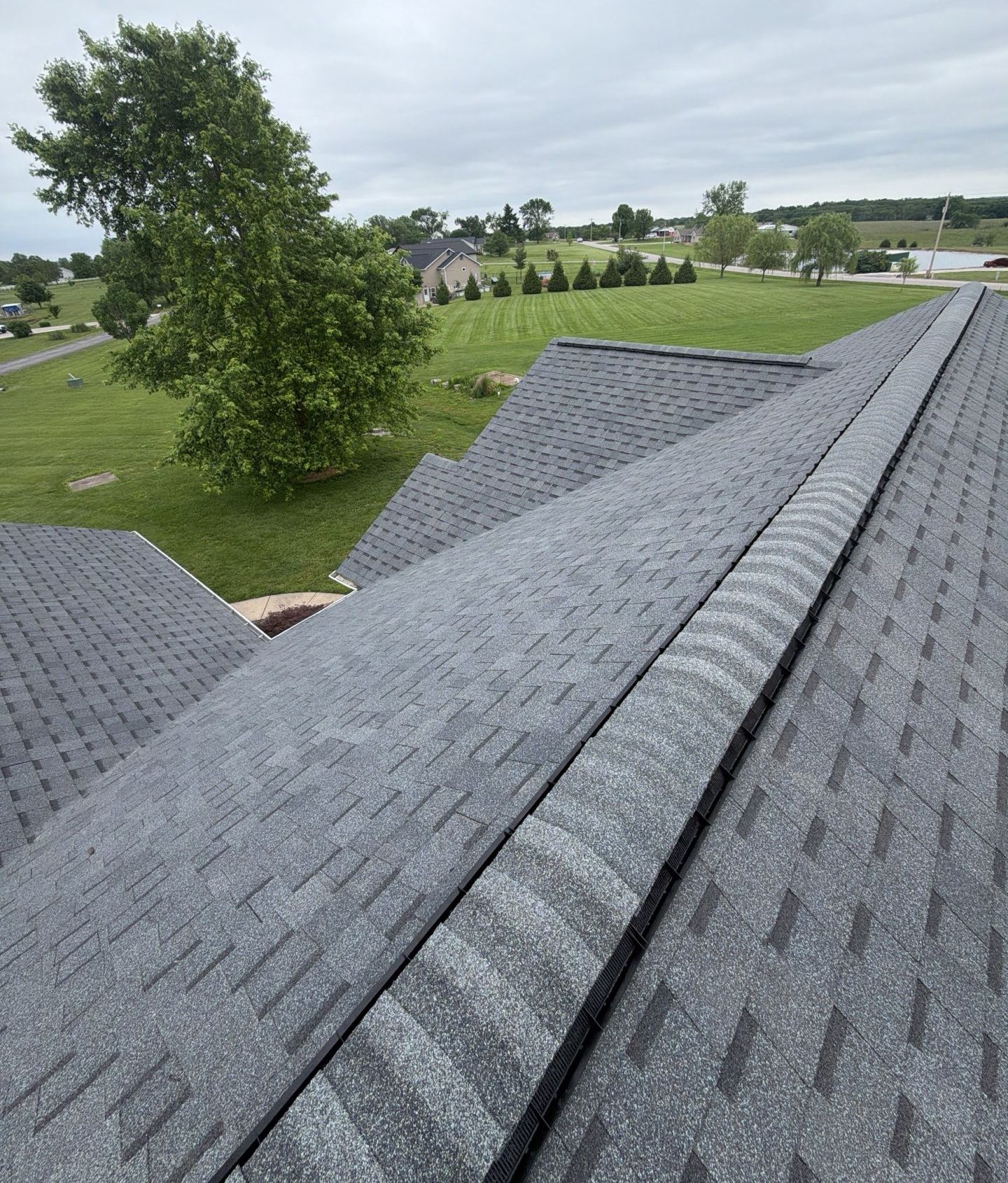
What Hail and Wind Do to a Roof
Hail damage rarely looks dramatic from the street. A real hail bruise usually shows displaced granules with a soft, crushed shingle mat underneath, and the hits land in a random pattern because hail does not fall in straight lines. Those soft spots can hold their shape in bright sun, which is how a roof that looked fine from the driveway turns into a leak months later.
Wind works differently. It creases shingles when tabs fold back, tears off tabs, and breaks the sealant bond that holds shingle edges down, mostly on the slopes facing the weather and along ridges and rakes, where uplift is strongest. Soft metals tell the truth on both: vents, flashing, gutters, downspouts and window screens hold dents at hail sizes shingles can shrug off. More in what the insurance adjuster is looking for on your roof.
What to Check From the Ground
You do not need a ladder, and we would rather you stayed off the roof. Walk the property and look for:
- A heavy dose of granules at the downspout discharge or splash block right after hail.
- Shingle pieces, flashing or soft metal debris in the yard.
- Lifted, curled or missing shingles along the edges, or a ridge line that looks uneven. Binoculars help.
- Fresh, clustered dents in the gutters, or gutters pulling away from the fascia.
- Dented vent covers or other metal on the roof.
Any of these is a reason to get the roof inspected soon rather than waiting for a ceiling stain. See reading your roof after a storm, from the ground.
Post-Storm Emergency Response
Post-storm emergency response and emergency repairs are part of what Keys Roofing handles for homeowners. We respond to every inquiry within 24 hours, and our hours are Monday through Saturday, 7am to 7pm, at (314) 220-2333. If weather beats us to your roof, note the storm date, photograph what you can see from the ground, and get on the schedule. Kaleb, who owns Keys Roofing, personally walks storm-damaged roofs and adjuster meetings with his crew.
How a Storm Damage Claim Actually Goes
Every policy and carrier is different, and your policy is the final word on coverage. We do not promise claim approvals or payout amounts. The general order, laid out in full in a hail claim from start to finish:
- Inspection with photos, before you file. We walk and photograph the roof and the collateral damage around it, then tell you straight whether what we found is worth a claim. Sometimes it is not, and we say so.
- Filing. You open the claim with your carrier. Keep the claim number, the storm date and every document.
- The adjuster meeting. We meet your adjuster at the property as the contractor and walk the roof together so everything we documented gets looked at. Missouri law does not permit a roofing contractor to negotiate your claim, so the claim stays yours. See how to be ready for the adjuster meeting.
- Scope and supplements. We read the carrier's scope of loss line by line. If tear-off reveals damaged decking, or the scope skips code or manufacturer items like ice and water protection or drip edge, we photograph it and submit a supplement. Approval is the carrier's call. See what a supplement is.
- The build and the final paperwork. We replace the roof to manufacturer spec, then our office sends the completion paperwork so recoverable depreciation the carrier held back does not go uncollected.
Your Deductible, Straight Talk
Your deductible is your share of the loss, set by your policy. Many carriers now use a percentage deductible for wind and hail, based on your home's insured value, which can be larger than homeowners expect, so find it on your declarations page before storm season. Missouri law prohibits contractors from paying, waiving or rebating an insurance deductible, and Keys Roofing will not offer to. If paying it in one piece is a hardship, talk to us about timing. Details in roof deductibles, straight talk.
How to Vet a Roofer After a Storm
After a big hailstorm, the door knocking starts fast, and some crews follow storms from state to state. Before you sign anything, ask: Where is your physical office in this metro? Who does the work, and who supervises the site? Can I see proof of insurance and licensing? Which local roofs did you finish more than a year ago? Is the workmanship warranty in writing?
Walk away from anyone who offers to cover your deductible, pushes you to sign today, wants a large deposit before material shows up, or calls a roof totaled without photographing it. You have time, and you are never required to use the company that knocked first. The full checklist is in how to vet a roofer after a storm.
Hail in St. Louis County: The NOAA Numbers
Hail is common here. In the NOAA Storm Events Database, St. Louis County logged 125 hail reports from 2020 to 2025, more than double the next county on the list, and 93 of them came in 2025 alone.
| County | Hail reports, 2020 to 2025 | Largest hailstone |
|---|---|---|
| St. Louis County, MO | 125 | 2.5 in |
| St. Charles County, MO | 54 | 3.0 in |
| Jefferson County, MO | 44 | 2.75 in |
| Madison County, IL | 35 | 3.75 in |
| St. Clair County, IL | 32 | 2.5 in |
| Franklin County, MO | 30 | 3.0 in |
The counts are NOAA-logged reports, not distinct storms, since one storm can produce several reports in the same county. The largest stone in the set, 3.75 inches, fell in Madison County, Illinois, in March 2024. St. Louis City has zero reports on file for those years. Method and source in St. Louis hail by county: the NOAA numbers.